

Short answer: Bid leveling is the process a general contractor uses to adjust subcontractor bids to the same scope, so the bids can be compared on price alone. The estimator reads each proposal, lines up what every bidder included and excluded against one scope of work, adds a plug for each missing item, separates alternates and allowances, and compares the adjusted (leveled) totals instead of the quoted ones.
Key takeaways
- Subcontractors price the same package differently: different inclusions, exclusions, assumptions and alternates. Quoted totals are rarely comparable.
- Leveling measures every bid against one scope of work, not against the other bids.
- A plug is the estimated cost of scope a bidder left out. Adding plugs turns quoted totals into leveled totals.
- The lowest quoted bid is often not the lowest leveled bid.
- Scope found before award is a pricing decision. Scope found after award is usually a change order or GC cost.
What is bid leveling?
On a commercial project, the general contractor buys most of the work from subcontractors, one trade package at a time. Each package usually gets several bids. Those bids arrive in each subcontractor’s own format, priced against their own reading of the drawings and specifications, with their own list of exclusions and qualifications.
Bid leveling, sometimes called bid normalization, is the work of making those bids comparable. Autodesk’s BuildingConnected documentation describes it the same way: finding the discrepancies between bids so the quotes are equal for comparison. The output is a bid tab, or leveling sheet: one row per scope item, one column per bidder, with every gap and adjustment visible.
Leveling is different from the owner-side bid evaluation used in public procurement, where bids are usually judged as responsive or not against fixed bid documents. A general contractor buying subcontract work has more freedom: it can clarify scope with bidders, plug what is missing and carry the bid that offers the best value once everything is on equal terms.
Why does bid leveling matter?
Because the risk in a subcontract bid is rarely the number on page one. It is what the number leaves out. An excluded item that nobody catches before award does not disappear. It comes back during construction as a change order, a back-charge dispute or cost the general contractor absorbs.
Construction Dive’s list of common bidding mistakes makes the same point: make sure there are no scope gaps between subcontractor bids, because work a subcontractor lists as an exclusion still has to be covered somewhere else. Research on public projects points the same way. A study of 610 Kentucky highway projects found that contract omissions, work left out of the contract, were consistently among the leading causes of change orders (Taylor et al., 2012). Those were owner contracts rather than subcontracts, but the mechanism is the same: work nobody priced still has to be built and paid for.
Leveling also protects relationships. Subcontractors who see their bids compared fairly, on the same scope, are more willing to keep bidding your work.
How do you level subcontractor bids?
- Write the scope of work first. List every item the package must cover, from the drawings, specifications and addenda. See how to write a subcontractor scope of work.
- Build the bid tab from that scope. One row per scope item, one column per bidder, plus a column for your own estimate.
- Read every proposal in full. The base bid is on the first page. Exclusions, qualifications and clarifications are usually at the end.
- Mark each scope item for each bidder. Included, not included or unclear.
- Clarify with bidders. Ask about anything unclear before you plug it. A short scope review call often settles it.
- Plug the gaps. For each item a bidder left out, add an estimated cost from your estimate, another bidder’s price or historical cost.
- Separate alternates, allowances and unit prices. Keep them out of the base bid comparison so they don’t distort it.
- Check addenda. Confirm every bidder acknowledged every addendum.
- Compare leveled totals. Look at the leveled total, then at each bidder’s qualifications and coverage of high-risk items.
- Record the decision. Keep the leveled tab and the reason for the award with the job, so the project team knows what was bought.
For a fuller method, read how to compare subcontractor bids.
A worked example
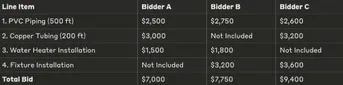
This plumbing bid tab shows three bidders on a small package. On quoted totals, Bidder A looks cheapest at $7,000. But each bidder left out a different item: Bidder A excluded fixture installation, Bidder B excluded copper tubing and Bidder C excluded water heater installation.
To level them, plug each missing item. Here the plug is the average of the other two bidders’ prices for that item. In practice, use your own estimate where you have one.
| Bidder A | Bidder B | Bidder C | |
|---|---|---|---|
| Quoted total | $7,000 | $7,750 | $9,400 |
| Plug for missing item | $3,400 | $3,100 | $1,650 |
| Leveled total | $10,400 | $10,850 | $11,050 |
After leveling, every bid is more than $10,000. The spread between the low and high bid falls from $2,400 to $650, and the decision now rests on a $450 difference between A and B, not $750. That is the real comparison, and the one to clarify with bidders before award.
What are the most common bid leveling mistakes?
- Comparing bids to each other instead of to the scope. Work that every bidder left out stays invisible.
- Reading only the bid form. Exclusions and qualifications in the attached proposal change what the number covers.
- Rolling alternates into the base bid. It makes bids look more or less complete than they are.
- Retyping numbers by hand. Copying proposals into a spreadsheet on bid day is where formulas break and numbers get transposed.
- Losing track of revisions. A revised bid can quietly drop something the first one carried.
- Leveling too late. Scope found after award is no longer a bid-day decision. It is a change order.
Should you level bids in Excel or in software?
Most estimators still level in Excel. It is flexible and familiar, and for a small package with a few bidders it works well. It gets harder with many bidders, late revisions and more than one estimator in the file, because every proposal has to be read and retyped, and nothing links a number back to the page it came from. See the Excel bid leveling alternative.
Bid management platforms such as BuildingConnected and Procore include bid leveling for the numbers bidders enter into a bid form. Procore markets an AI Bid Leveling Agent, and Autodesk has a Bid Proposal Agent in beta that reads proposal PDFs. Dedicated AI bid leveling tools, Consight among them, read each proposal, map it to your scope and link every finding to its source, with the estimator still making the call. Consight publishes this article. For a fair look at where each tool fits, read the best bid leveling software compared.
Frequently asked questions
What is the difference between bid leveling and bid tabulation?
A bid tabulation lists the bids received side by side. Bid leveling goes further: it adjusts each bid for missing or extra scope so the totals compare on the same scope.
What is a plug in bid leveling?
A plug is an estimated cost added to a bid to cover scope the bidder missed, excluded or underpriced, so every bid is measured on the same scope.
Who does bid leveling?
Usually the general contractor’s estimator or preconstruction manager responsible for the bid package, with a second reviewer on the largest packages.
Sources
- Autodesk, BuildingConnected Help Center, Bid leveling.
- Kim Slowey, “7 bidding mistakes that can throw off a project,” Construction Dive, August 26, 2020.
- Timothy R. B. Taylor et al., “Change Orders and Lessons Learned: Knowledge from Statistical Analyses of Engineering Change Orders on Kentucky Highway Projects,” Journal of Construction Engineering and Management 138(12), 2012. doi:10.1061/(ASCE)CO.1943-7862.0000550
Related reading: what is AI bid leveling, how to compare subcontractor bids and how to find scope gaps in subcontractor bids.
Where Consight fits
Consight is the preconstruction workspace built around this kind of work—from understanding project documents and building scopes to collecting bids, leveling proposals, reviewing risk, and documenting the final award.
Put it into practice on your next project.
Talk to sales