

The best construction bid leveling software depends on your bottleneck. BuildingConnected fits teams that need to find and invite subcontractors. Procore fits teams that want bidding inside the platform they already run projects in. DESTINI Bid Day fits teams on DESTINI Estimator. PlanHub fits contractors looking for more projects to bid. Consight fits teams that want one platform for scope, invitations to bid, and bid leveling.
Consight publishes this comparison and is one of the five tools in it. Each product is described from its own public documentation, listed alphabetically, and the method is at the end of the page.
Choosing preconstruction software depends heavily on which part of bidding you’re trying to improve. Some platforms are strongest at finding subcontractors. Others manage invitations. Others provide estimating systems. And a newer category uses AI to run the whole job, from reading project documents to leveling subcontractor proposals. The comparison below covers BuildingConnected, Consight, DESTINI Bid Day, PlanHub, and Procore based on the jobs commercial preconstruction teams perform every day.
Quick comparison
| Platform | Bid leveling | AI reads proposals | Subcontractor network | Invitations to bid |
|---|---|---|---|---|
| BuildingConnected | Yes | No | Yes | Yes |
| Consight | Yes | Yes | No | Yes |
| DESTINI Bid Day | Yes | Not advertised | Not advertised | Not advertised |
| PlanHub | Yes | Not advertised | Yes | Yes |
| Procore | Yes | Yes | Yes | Yes |
Best for and ecosystem
| Platform | Best for | Ecosystem |
|---|---|---|
| BuildingConnected | Sub network and ITBs | Autodesk |
| Consight | Scope, bidding, and leveling | End-to-end preconstruction |
| DESTINI Bid Day | DESTINI estimating users | DESTINI by Beck Technology |
| PlanHub | Finding projects | Bidding marketplace |
| Procore | All-in-one platform | Full construction management |
Best for subcontractor network: BuildingConnected
BuildingConnected’s major advantage is network scale. Autodesk markets access to more than 1.5 million construction professionals, one of the largest subcontractor networks, alongside bid invitations, bid leveling with plugs, and historical bid data. Autodesk is also testing AI on the proposals themselves. Its Bid Proposal Agent is in beta in Autodesk Forma’s bid tool, not in BuildingConnected. It reads proposal PDFs and pulls out costs, inclusions, and exclusions.
BuildingConnected is most useful for sourcing bidders and running ITBs. Read Consight vs BuildingConnected.
Best for end-to-end scope, bidding, and leveling: Consight
Consight runs the work between construction documents and subcontract award in one place. Its AI drafts scope sheets by trade from plans and specs. Bidvite, its invitation to bid tool, sends each trade its scope with the plans and specs attached. It tracks who opened, committed, and declined, sends reminders, and flags trades that are thin on bidders. Subcontractors respond and submit bids without an account, and each bid lands in its package.
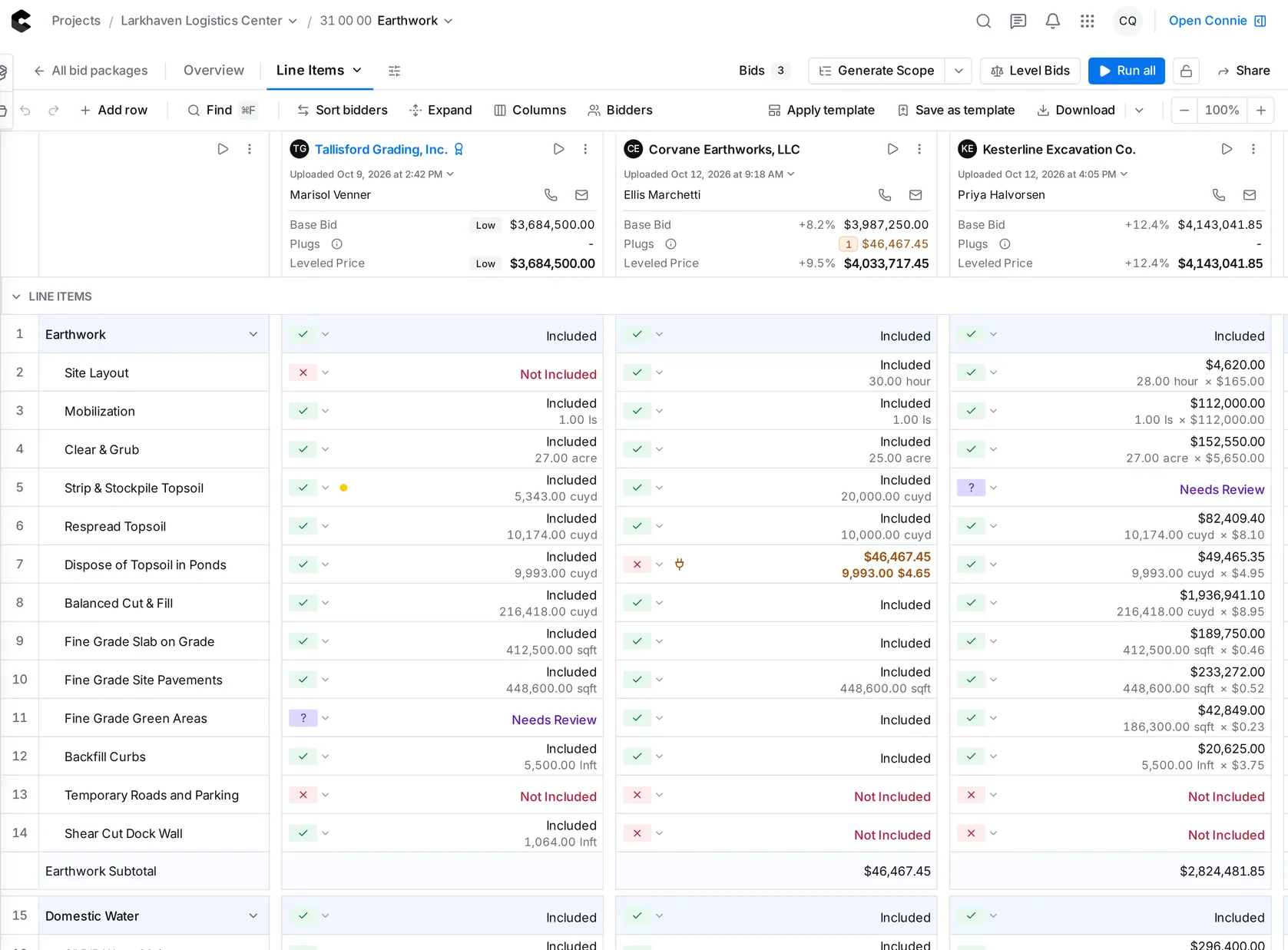
Consight then reads each proposal and maps it to the same scope sheet. It marks each line included, not included, or needs review, and links every value to its spot in the proposal. Estimators add plugs and make the call.
Consight has no public bidder network, so teams invite from their own bidder lists. Teams that keep BuildingConnected or Procore for invitations can import projects and bids from them instead. It suits teams whose estimators still rebuild scopes and copy proposals into Excel.
Consight Pro is one plan, priced by quote for your whole organization, with every member and a monthly AI budget included. See pricing and Consight bid leveling.
Best for DESTINI users: DESTINI Bid Day
Beck Technology markets DESTINI Bid Day for apples-to-apples bid comparisons that identify gaps, overlaps, and exceptions across subcontractor proposals, and it syncs bid data into DESTINI Estimator. Teams already using Beck Technology’s estimating ecosystem should put it high on their shortlist. Read Consight vs DESTINI Bid Day.
Best for finding opportunities: PlanHub
PlanHub emphasizes project discovery, a network of general contractors, subcontractors, and suppliers, ITBs with automatic matching, prequalification, takeoff, and market intelligence. It is particularly relevant to subcontractors and contractors trying to increase opportunity volume, rather than to leveling bids already received. Read Consight vs PlanHub.
Best broad construction platform: Procore
Procore covers much more than bid leveling. Its bidding tools support bid forms and side-by-side leveling. Procore markets an AI Bid Leveling Agent that standardizes trade bids, surfaces buried exclusions and missing deliverables, and compares proposals against specs and drawings. It is likely to be most attractive to organizations that want bidding inside a wider construction-management platform. Read Consight vs Procore.
Which bid leveling software should you choose?
- If the bottleneck is finding bidders: BuildingConnected.
- If the bottleneck is finding projects: PlanHub.
- If the bottleneck is connecting bid leveling into DESTINI estimating: DESTINI Bid Day.
- If you want bidding inside the platform you run projects in: Procore.
- If you want scope, invitations, and leveling in one AI platform built for preconstruction: Consight.
Whichever you shortlist, test it on one of your own recent packages, with the messy proposals and late revisions left in.
What should large general contractors look for?
At a $500M to $5B+ general contractor, hundreds of proposals can land on one bid day, across dozens of trades and estimators. The risk is rarely the number a subcontractor quoted. It is the scope they quietly left out. Large GCs should weigh:
- Leveling against scope, not just against other bids. Comparing proposals to each other misses scope that none of them carried. See scope gap detection software.
- Pricing the gaps. Missing scope should become a plug with a number, so a low quote that excludes controls and firestopping shows up as a higher leveled total.
- Traceability. Every extracted line and flagged exclusion should link back to the exact text in the source proposal.
- Messy inputs. Real proposals arrive as PDFs, spreadsheets, Word files, and scanned pages, with revisions.
- One scope from start to finish. The scope you send bidders should be the scope you level against, so nothing is retyped between tools.
- Integration with your bid platform. Many large GCs already run BuildingConnected, Procore, or both. The software should import from them, or run invitations itself when you are ready to move.
- Enterprise security. SSO, role-based access, tenant isolation, data residency, and how AI providers handle your documents.
- Estimator control. The software should do the reading. The estimator should still make scope, coverage, and award decisions.
Bid management platforms such as SmartBid focus on bidder lists, invitations, and document distribution, so evaluate them on outreach rather than proposal reading. Newer AI-first tools, such as MeltPlan and Piper, also read proposals and level them against scope. Whichever you evaluate, check enterprise security, integrations, and customer references at your revenue size. The AI bid leveling RFP checklist and how to pilot AI bid leveling software cover how to run that evaluation.
Consight’s largest customers are $500M to $5B+ general contractors. Preconstruction teams at Clayco, Gray Construction, Alston Construction, W.M. Blanchard, and NRP use it. Across Consight customers, $12B+ in project value has been managed on Consight, 450k bids leveled, and 380k scope gaps flagged to date (Consight platform data). Read more about AI bid leveling for $500M to $5B+ general contractors.
Methodology
We reviewed each product’s publicly available product documentation in October 2026 and compared it against common commercial general contractor preconstruction workflows. A dash in a table means the product does not offer the capability, or its public pages do not describe it.
For another vendor, a dash does not prove the product cannot do it. Consight publishes this comparison and therefore has a commercial interest in the evaluation. We encourage buyers to evaluate each product independently.
Related: Consight bid leveling, AI scope generation, Bidvite invitations to bid, BuildingConnected integration, Procore integration, and talk to sales.
Where Consight fits
Consight is the preconstruction workspace built around this kind of work—from understanding project documents and building scopes to collecting bids, leveling proposals, reviewing risk, and documenting the final award.
Put it into practice on your next project.
Talk to sales