

Short answer: The BuildingConnected alternatives general contractors usually compare are ConstructConnect (which owns SmartBid and iSqFt), PlanHub, Procore Bid Management and Dodge Construction Network. Which one fits depends on what you want to replace.
If it is the subcontractor network and invitations to bid, look at PlanHub, SmartBid or Procore. If it is finding projects before they bid, look at ConstructConnect or Dodge. If bids already arrive fine but your estimators lose days comparing them, the network is not the problem: keep BuildingConnected and add a bid leveling tool such as Consight. Consight is not a bidder network.
Consight publishes this page and sells one of the tools on it, so weigh it accordingly. We describe every other product from its vendor’s own pages as of October 2026, and the method is at the end.
BuildingConnected alternatives compared
Listed alphabetically, with BuildingConnected first for reference and Consight last because it is ours.
| Tool | What it is for | Network and invitations | Bid leveling | Pricing, as the vendor publishes it | Who it fits |
|---|---|---|---|---|---|
| BuildingConnected | Bid management on Autodesk’s builder network | 1.5M+ construction professionals; bid invites | From bid form entries; an AI proposal reader in beta | BuildingConnected Pro, Bid Board Pro and TradeTapp by quote | GCs that want the largest network to invite from |
| ConstructConnect | Project leads, takeoff, and bid management in one vendor | Bid management line includes SmartBid and iSqFt; leads from 825,000+ researched projects | Through SmartBid | Project Intelligence from $129 a month per market, per seat; takeoff from $100 a month | Teams that want leads and bidding from one company |
| Dodge Construction Network | Finding projects early, before bids go out | Project intelligence, not a bid workflow | Not a leveling tool | No standard price list; customized by data, region and users | Business development that wants projects sooner |
| PlanHub | Preconstruction marketplace for GCs, subs and suppliers | 500,000+ commercial construction professionals; ITBs | “Basic Bid Leveling” free; “Adv. Bid Leveling” in Pro | Free, unlimited access for GCs; paid GC tiers unpriced; subcontractor Premier from $1,999 a year | GCs that want a free place to post projects |
| Procore Bid Management | Bidding inside the Procore project platform | Invitations to bid, bid forms, prequalification | Side-by-side comparison | Annual fee based on construction volume, no charge per user | GCs already running projects in Procore |
| SmartBid | GC bid management with your own subcontractor database | ITBs to your sub list; subcontractors respond at no cost | BidTabs, side by side | Not published; scales annually with the number of users | GCs that want to own their bidder list and ITB tracking |
| Consight (ours) | AI bid leveling and scope generation | No network. Invitations are coming soon; bids import from BuildingConnected or Procore | AI reads each proposal and levels it against your scope sheet | $199 per user a month billed annually, $219 monthly, for teams of 1 to 3; Enterprise for larger teams | Estimators leveling proposals by hand in Excel |
How to choose
Start with the problem, not the product. Not enough bids, or a network that costs too much? Switch the network. Pick Procore if your projects already live there, PlanHub for a free GC tier, or SmartBid to keep your own sub list.
Bidding on projects too late? Add a leads service such as ConstructConnect or Dodge, which work before a bid tool, not in place of one. Enough bids, but leveling eats the week? Keep the network you have and fix the leveling.
Who pays for BuildingConnected, PlanHub, ConstructConnect, SmartBid and Procore?
In most bid management tools, the general contractor pays and invited subcontractors bid for free. PlanHub reverses that model. PlanHub gives general contractors free access and charges subcontractors for leads by radius. ConstructConnect, which now includes iSqFt, charges mainly for project leads. Of the five, only ConstructConnect and PlanHub publish any prices, and only for some plans.
| Tool | What the GC pays | What the subcontractor pays |
|---|---|---|
| BuildingConnected | BuildingConnected Pro is the paid subscription for general contractors, by quote | Bid Board is free for subcontractors; Bid Board Pro is paid, by quote |
| ConstructConnect (iSqFt) | Project Intelligence from $129 a month per market and seat; Premium from $10,000 a year; bid management not priced | Invited subs bid "even without a subscription"; leads from $129 a month per market and seat |
| PlanHub | Free, unlimited access; Pro, Premier and Enterprise tiers not priced | Premier $1,999 a year for 50 miles, $2,349 for 100 miles, $3,299 for 200 miles; Enterprise custom |
| Procore Bid Management | Annual fee by product, based on annual construction volume; unlimited users; by quote | No fee stated; bidders can reply to the invitation email with the bid attached |
| SmartBid | Not published; scales annually with the number of users | Invited subs get access at no cost |
| Consight (ours) | $199 per user a month billed annually, $219 monthly, for teams of 1 to 3; Enterprise for larger teams | Nothing; subcontractors need no Consight account |
Is PlanHub better than BuildingConnected?
It depends on who is paying and what you need. PlanHub says general contractors get free, unlimited access, and its free tier includes basic bid leveling, so it is cheaper to post work on.
PlanHub’s subcontractor plans start at $1,999 a year for a 50-mile radius. BuildingConnected’s network is larger by both vendors’ own counts: Autodesk cites 1.5M+ professionals, PlanHub 500,000+. Autodesk sells BuildingConnected Pro by quote; is BuildingConnected worth it covers what it costs a GC.
A GC that wants the widest invite list usually stays on BuildingConnected; one that wants a free channel, or more project discovery, adds PlanHub. Many use both. Consight vs PlanHub covers how PlanHub relates to leveling.
BuildingConnected vs ConstructConnect: which is better for general contractors?
They solve different first problems. ConstructConnect starts with finding work: its comparison page describes 825,000+ active projects verified by 400+ researchers, and it sells takeoff (On-Screen Takeoff, PlanSwift) and bid management (SmartBid) alongside. BuildingConnected starts with running the bid: inviting subcontractors from Autodesk’s network, collecting bids on your bid form and leveling them.
ConstructConnect’s own page notes that users submit BuildingConnected’s project listings. That is a fair point for a subcontractor hunting leads, and it matters less to a GC that already has the drawings. A GC that mostly needs to bid its own work well tends to prefer BuildingConnected. A GC that also wants a leads database and takeoff from one vendor tends to prefer ConstructConnect.
BuildingConnected vs SmartBid: which bid management tool should a GC use?
Both send invitations to bid, collect bids, prequalify subcontractors and compare bids side by side. The difference is the network. BuildingConnected invites from Autodesk’s shared network of builders. ConstructConnect acquired SmartBid from JBKnowledge in 2018. SmartBid centers on the subcontractor database you maintain, with prequalification on ConsensusDocs 721.
Pick BuildingConnected if you want reach to subs you have never worked with; pick SmartBid if you bid mostly to a known list and want it under your control.
Is SmartBid worth it, and what does it cost?
SmartBid does not publish prices. Its pricing page says customers scale access annually by the number of users and that subcontractors respond at no cost. It is worth a quote if your team bids repeatedly to the same few hundred subcontractors and wants BidTabs, prequalification and ITB tracking in one place. It is a weaker fit if you depend on finding new bidders in unfamiliar markets.
iSqFt vs BuildingConnected
iSqFt is no longer a separate company. iSqFt started in 1993 and merged into ConstructConnect in 2016. ConstructConnect is moving iSqFt users onto its own platform: its migration page says “You’ll now ONLY have access to ConstructConnect”. So the real comparison today is BuildingConnected against ConstructConnect, above. Current iSqFt users choosing between the two should compare ConstructConnect’s bid management and SmartBid with BuildingConnected, not the old iSqFt product.
Where does Procore fit?
Procore Bid Management suits GCs that already run projects in Procore and want bidding in the same system, priced by construction volume rather than per user. Procore vs BuildingConnected for bid management covers that choice, and Consight vs Procore covers Procore’s own bid leveling.
Consight vs BuildingConnected at a glance
Consight is not a replacement for BuildingConnected’s network. It handles the work after plans, specifications and proposals arrive: generating scopes, reading proposals, leveling bids and finding scope gaps with AI.
| Capability | Consight | BuildingConnected |
|---|---|---|
| Invite subcontractors | Coming soon; most teams invite in BuildingConnected | Core strength |
| Large subcontractor network | No; imports bidders from BuildingConnected | Major strength |
| Bid packages and bidder tracking | Yes | Yes |
| AI-generated scope sheets | Core capability | Not advertised |
| AI that reads proposal PDFs | Core capability | Autodesk’s Bid Proposal Agent, in beta |
| Bid leveling | Against your own scope sheet | From bid form entries, with plugs |
| Detect missing scope and exclusions | Core workflow | Plugs and review; exclusions read by the beta agent |
| Trace findings to original proposal | Yes, for extracted values | Source PDF linked in the beta agent |
| Plan and spec Q&A | Yes | Not advertised |
| Historical bidding data | Templates and packages reused from past projects | Historical bid data and analytics (BuildingConnected Pro) |
Autodesk positions BuildingConnected around bid management, its network, bid invitations, bid leveling, custom bid forms and historical bid data, with TradeTapp for subcontractor prequalification.
Autodesk is also testing AI on proposals. Its Bid Proposal Agent is a beta that you switch on for each request for proposal. It extracts the line items, scope included and scope left out from each subcontractor PDF. BuildingConnected bid leveling: limitations and fixes covers where BuildingConnected’s own leveling stops.
What is the biggest difference?
Managing bidders versus understanding the bid. BuildingConnected is strongest at the front end: building a bidder list, sending invitations, talking with subcontractors and tracking coverage. Consight focuses on what estimators do once documents and proposals arrive. Upload the plans, specifications and subcontractor proposals, or import them from BuildingConnected, and Consight can help:
- Generate trade scope sheets and bid forms
- Extract pricing and scope from subcontractor proposals
- Compare bidders side by side
- Identify exclusions and potentially missing scope
- Flag spec conflicts, where a bid contradicts the plans or specs
- Ask questions against project documents
- Trace findings back to the source bid
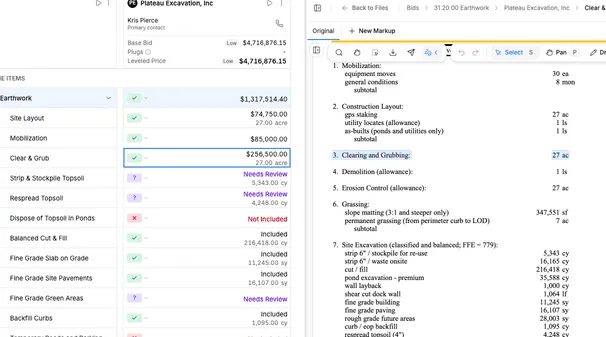
Imagine five mechanical subcontractors submit proposals. Knowing that five bids arrived is the easy part. The estimator needs to know: does every bidder carry the same scope? Who excluded controls? Who included permits? Is insulation in? Are the equipment allowances equivalent? Why is one bidder $180,000 cheaper? That is the part Consight is built to automate.
Can you use Consight and BuildingConnected together?
Yes, and for many contractors that is the strongest setup. BuildingConnected stays the system for bidder relationships and invitations; Consight takes over once proposals arrive, through scope analysis and leveling to the award. Contractors with years of bidder data in BuildingConnected do not have to rebuild their network. See how to level BuildingConnected bids.
Bottom line
- Choose BuildingConnected if bidder discovery, invitations and network depth are your main priorities.
- Choose an alternative network (PlanHub, SmartBid, Procore) if cost, control of your sub list, or staying in your project platform matters more.
- Add a leads service (ConstructConnect, Dodge) if the problem is finding projects early.
- Add Consight if you already get enough bids but still spend estimator hours turning proposals into an apples-to-apples comparison.
Frequently asked questions
Is Consight a BuildingConnected alternative?
For bid leveling and scope analysis, it can be. For the bidder network and invitations, no: Consight is designed to work alongside BuildingConnected.
Does Consight integrate with BuildingConnected?
Yes. Consight imports BuildingConnected projects, bid packages, bid form lines, submitted bids, files and contacts, and new bids keep arriving automatically after the first import. The connection is read-only: nothing is written back to BuildingConnected.
Methodology
We reviewed each vendor’s public product, pricing and comparison pages in October 2026 and compared them against common commercial general contractor preconstruction workflows. We show prices only where the vendor publishes them. “Not advertised” means the vendor’s public pages do not describe the capability, not that the product cannot do it.
We cite vendors’ own comparison pages as their claims, not as independent findings. Consight publishes this comparison and has a commercial interest in it, so evaluate each product yourself.
Related: best construction bid leveling software compared, Consight bid leveling, AI scope generation, BuildingConnected integration, Procore integration and talk to sales.
Where Consight fits
Consight is the preconstruction workspace built around this kind of work—from understanding project documents and building scopes to collecting bids, leveling proposals, reviewing risk, and documenting the final award.
Put it into practice on your next project.
Talk to sales